
The Semeuse: the adventure of an icon stamp in cartophily
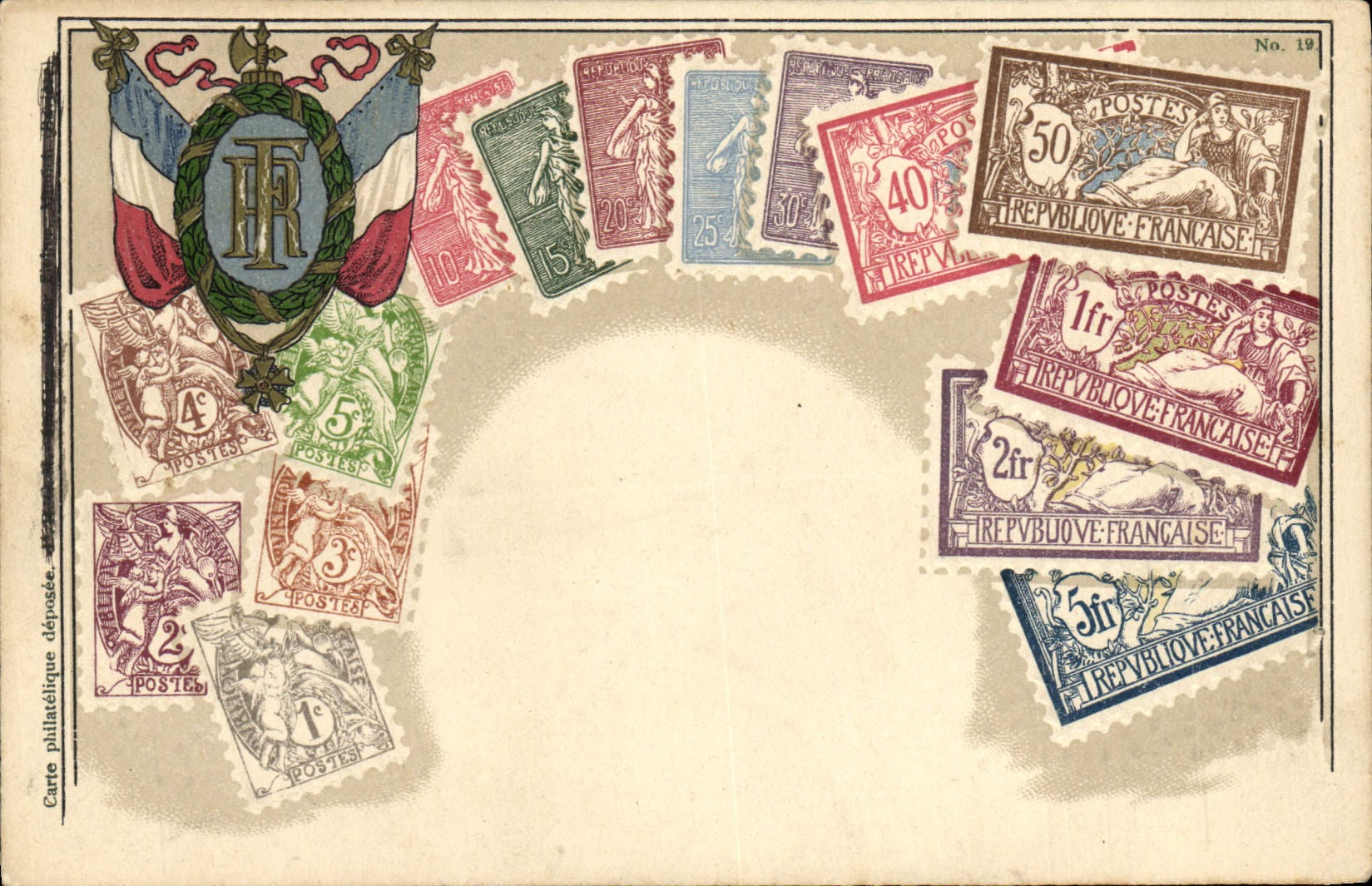
At the dawn of the century, the great powers of the age were brimming with initiatives to assert their influence across every sphere of the life of nations and their peoples. With its universal reach, the postal object was therefore an essential arena for affirming modernity and identity. In France, a whole set of postal vignettes was thus born that would leave their mark on France, its overseas territories and its colonies, but also on every correspondent who received these postage stamps — stamps that would frank letters, covers and postcards throughout the first quarter of the century.
In 1900 the Type Blanc appeared in France: five postage stamps that franked the majority of postcards of the period; then, in 1903, came the Semeuse, as well as the Merson type, which would also serve to frank heavier mail.
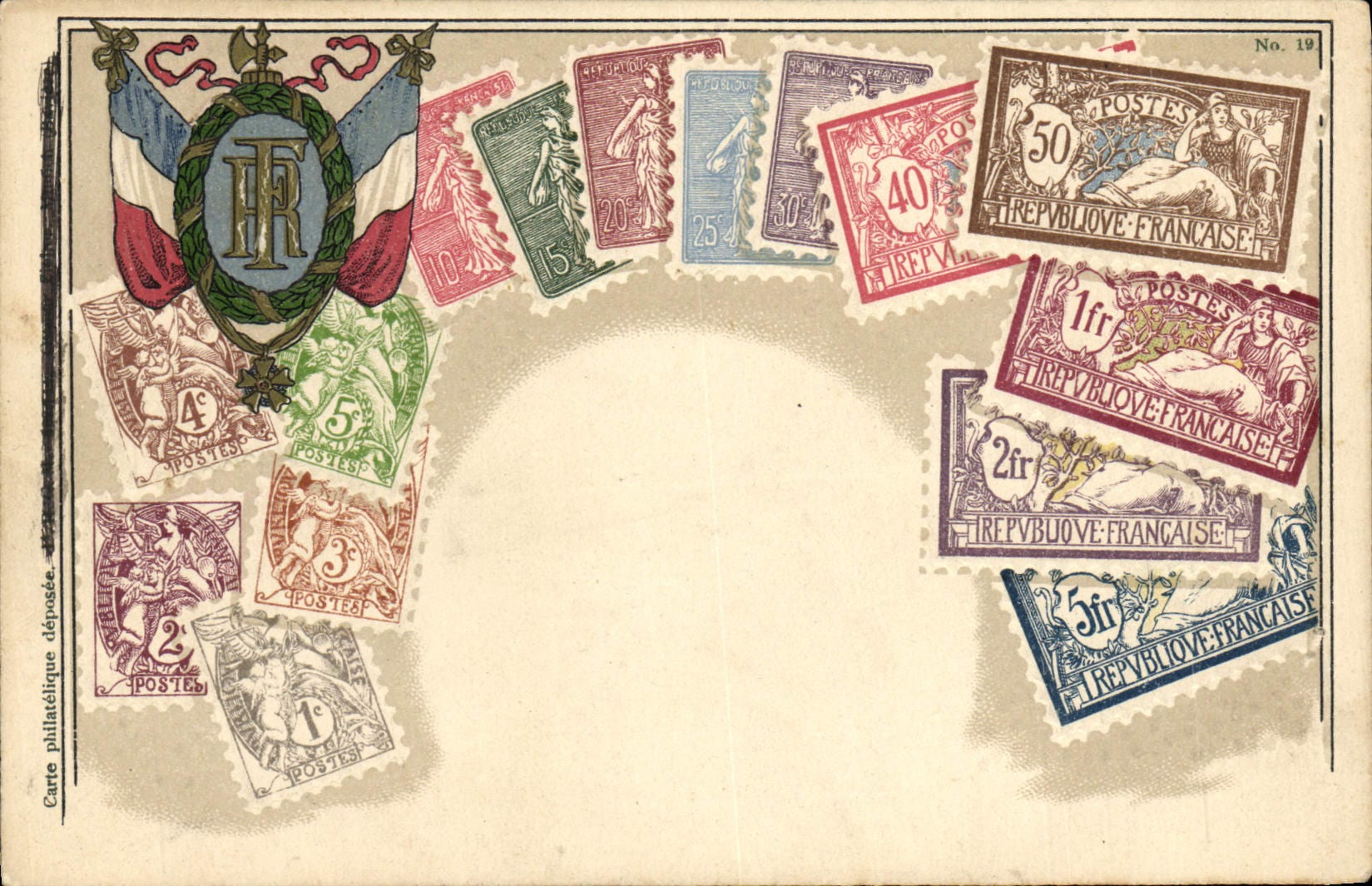
The first stamp issues of the new century (Type Blanc, Semeuse and Merson) brought together on a pictorial postcard.
The Origins of the Semeuse: a Republican Allegory
The Semeuse was born in 1897, thanks to the Finance Minister of the day, Georges Cochery, who wished to modernise French coinage. The aim, at the time, was to replace the royal or imperial effigies with an allegorical representation of the Republic. The engraver Oscar Roty (1846-1911) won the competition with his design: a woman in classical dress, walking through a field and broadcasting seed by hand. Her profile, inspired by the features of his wife, embodies fertility, progress and peace.
The first coin to bear the Semeuse was the 50-centime piece of 1897, followed by the 1- and 2-franc silver coins. Its success was immediate: at once poetic and political, the motif won over the French. The Semeuse quickly became a universal symbol, far beyond numismatics. The adventure would last a long time — for numismatists and for our purses alike — since this design survived, with only minor changes, until the end of the franc.
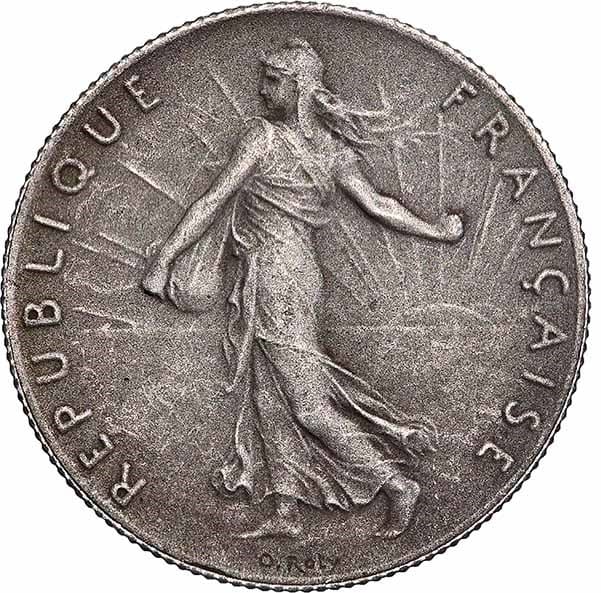

The first Semeuse coin: the 50-centime piece of 1897.
The Semeuse in philately: a quarter-century adventure
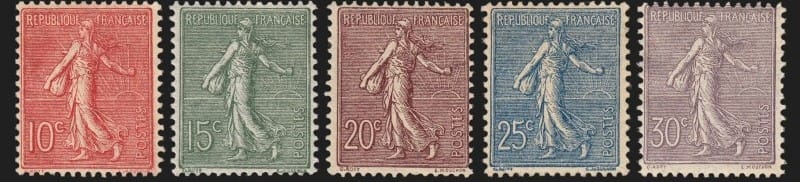
With the Type Blanc and bold symbols of a new modernity, the Semeuse soon went on to conquer the world of stamps. In 1903 the first stamp effigy of the Semeuse thus appeared, drawn by Eugène Mouchon and engraved by Jules Piel.
The arrival of the Semeuse unfolded in several stages:
The values of the Semeuse “lignée” (lined type) of 1903, ranging from 10c to 30c. To my eye, their design renders all the finesse of the engraving perfectly: these stamps are elegant, fairly scarce in the higher values (25c and 30c mint) and very widely used in others (the 10c for the postcard in particular, or the 15c for the letter).
The Semeuse “camée” (cameo type), with values between 5c and 35c, matching the various postage-rate tiers.

The Semeuse in cartophily: an eclectic field of research
The first area of interest of the Semeuse in cartophily concerns postage. Indeed, the earliest postcards are often covered with the green 5c Semeuse, which corresponds to the first mailing rate in France.
The Semeuse also corresponds to the franking of the first postal stationery cards, likewise labelled “postcard”, as shown by this rather untidy cover franked with the 10c value.

Semeuse 10c postal stationery addressed to Victor Gonfrey, in Meschede, Germany.
On the card that follows, the sender enjoyed franking exemption and franked the card with a 10c overprinted “FM” (for Franchise Militaire — military franking). In this case he was exempt from postage even though a stamp had been provided for in that spot!
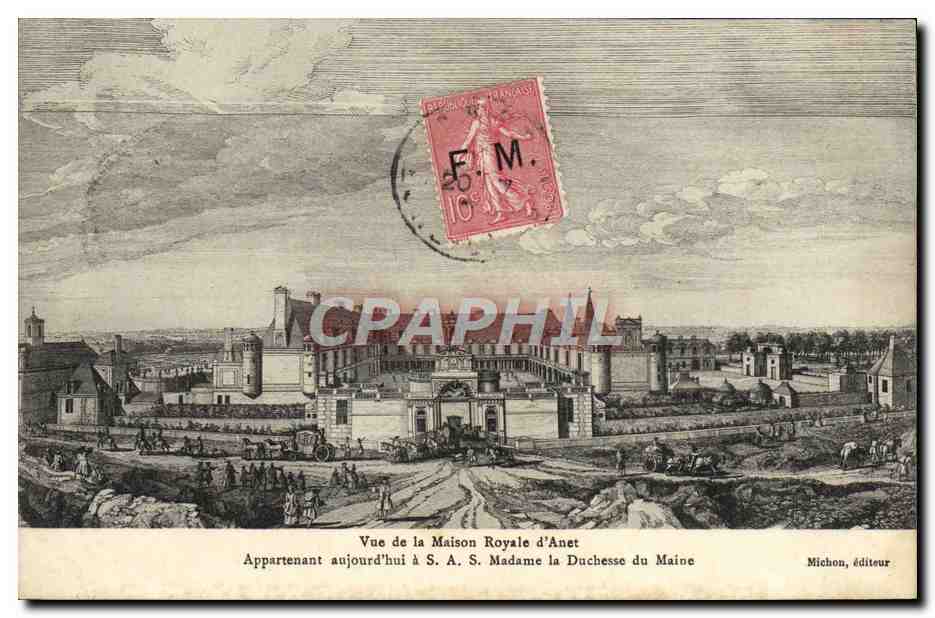
Postcard: View of the Royal House of Anet, franked with a Semeuse FM 10c stamp.
But our little stamp also gives free rein — and this is what interests us — to a very great diversity of creativity, notably through illustrated designs made up of cut-out postage stamps to embellish their subjects. On this card, two figures depicted in a manner that is not politically correct engage in an ostrich-egg battle. In those days, people were also very drawn to the exotic.
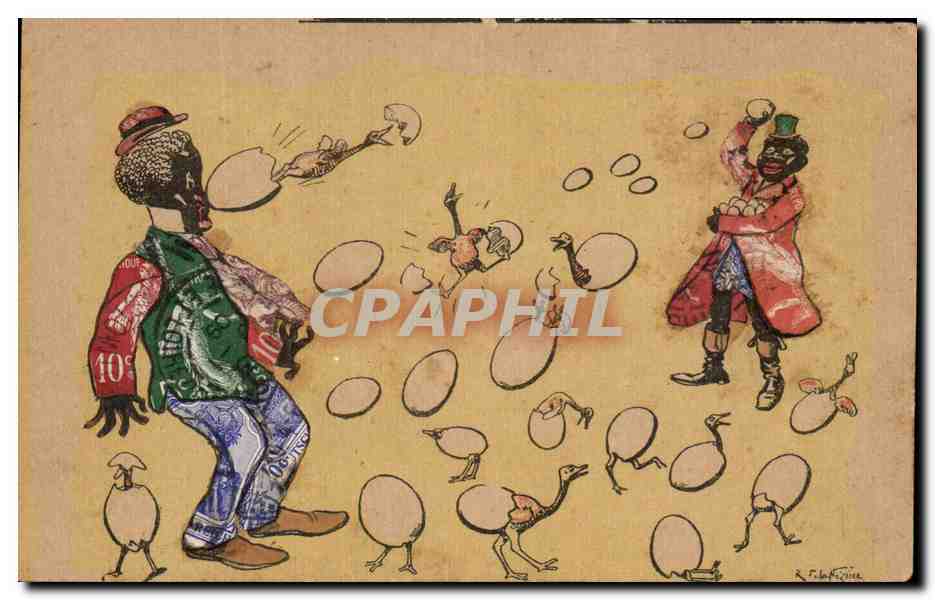
Postcard – “Ostrich-egg battle”. A composition made of Semeuse stamps.
More conventional, these embossed cards present our Semeuse in a large field, which is perfectly suited to highlighting the finesse of Roty's design. There is a fairly wide variety of cards with this presentation.
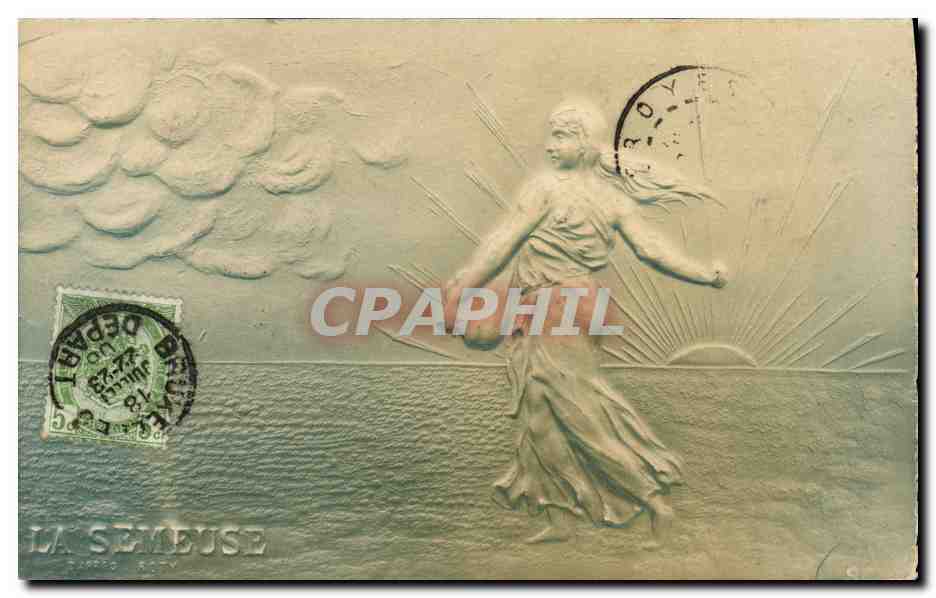
The Semeuse – Postcard.
But the letter — and the stamp — on the postcard can also carry a hidden meaning, depending on the orientation in which our Semeuse is stuck on each cover… Messages of friendship or of love… since correspondence so often carries a token of affection, one will readily understand: 360 degrees to orient a postage stamp will barely be enough…
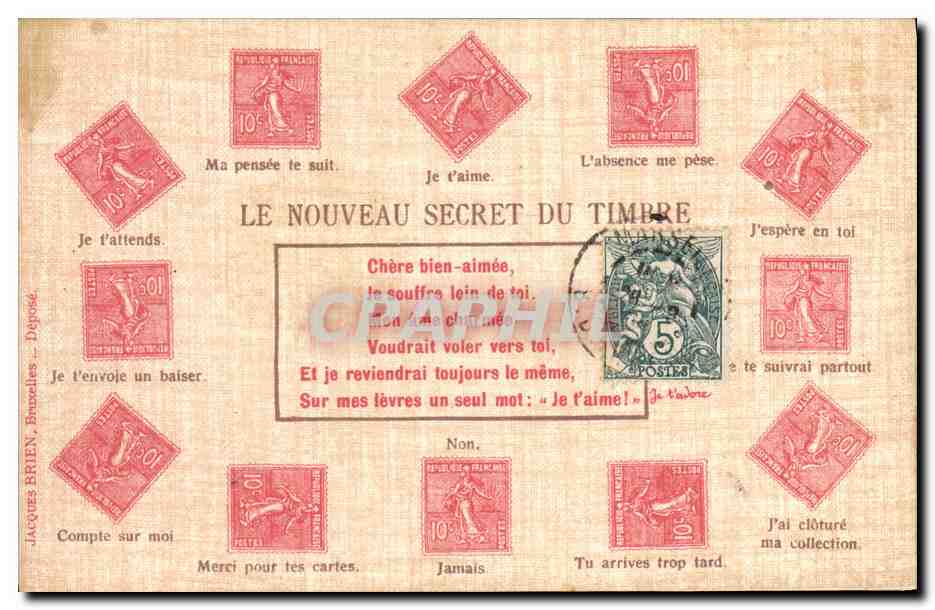
Postcard: “The new secret of the stamp”, a Semeuse 10c lignée.
How to collect?
The Semeuse in cartophily therefore covers a very broad spectrum of possibilities, leaving the collector free to personalise their searches and to steer their choices according to their own tastes.
One may thus favour the stamp on the card according to its postal use, or the postmarks striking our effigy — present on mail in France as in the colonies, and sometimes also locally overprinted.
The Semeuse also allows one to explore cross-cutting themes:
- French agriculture: stamps and cards showing the Semeuse among the fields.
- Republican symbols: a comparison between the Semeuse, Marianne and other allegories.
- The history of France: the use of the Semeuse during the wars, the Liberation or national celebrations.
One may also opt for hybrid collections, with mixed albums combining stamps (definitive or commemorative), postcards (vintage or modern), first-day covers (FDC) with a Semeuse cancel, and administrative documents (such as postal cheques or savings-bank vouchers) adorned with the Semeuse.